The Seth Raynor Archive / Templates

A vocabulary, not a formula

Raynor did not need to invent every strategic idea to make something original. He gave established concepts a new relationship with the land.

The engineer’s eye

The Geometry of Strategy: Raynor’s Engine of Adaptation

Seth Raynor approached golf architecture through the disciplines of surveying and civil engineering. He studied civil engineering at Princeton before practicing around Southampton, where the work of measuring land and making it serviceable preceded his golf career. That experience helps explain the clarity of his architecture: a plan must describe not just where a green sits, but its elevation, the ground leading into it and the movement of water around it. His greens and bunkers give strategic ideas a legible physical form.

A template is not a standard drawing to be stamped onto a property. It preserves a relationship: a diagonal green and a helpful shoulder, a concealed target beyond a ridge, or a long playing surface interrupted by a swale. The same relationship behaves differently on exposed coastal ground, lowcountry terrain or a plateau above a ravine. Soil, firmness and wind alter the shot; the available topography alters the routing and the shape of the approach. Repetition of an idea is compatible with individuality of execution.

Across Raynor’s work, familiar ideas appear at different scales and with different degrees of severity. Green depth changes the importance of distance control; the height of a shoulder changes how strongly it redirects a ball; bunker placement changes the price of a poor angle. Fishers Island’s coastal setting, Shoreacres’ ravines and Yale’s abrupt changes of elevation make those differences particularly apparent. These are variations to compare, not evidence of a simple career-long progression from mild to severe. Restoration and modern maintenance also influence what the golfer encounters today.

Charles Blair Macdonald brought the conceptual framework: celebrated holes overseas offered strategic qualities that could be adapted into an American course. Raynor’s surveying and construction work helped turn that ambition into National Golf Links of America, a Macdonald design rather than an independent Raynor commission. Raynor’s subsequent independent courses carried the vocabulary onto new properties with new combinations of hazards, contours and sightlines. His originality lies in that translation—retaining the question while changing the ground on which it is asked.

01 / Strategic study

Redan

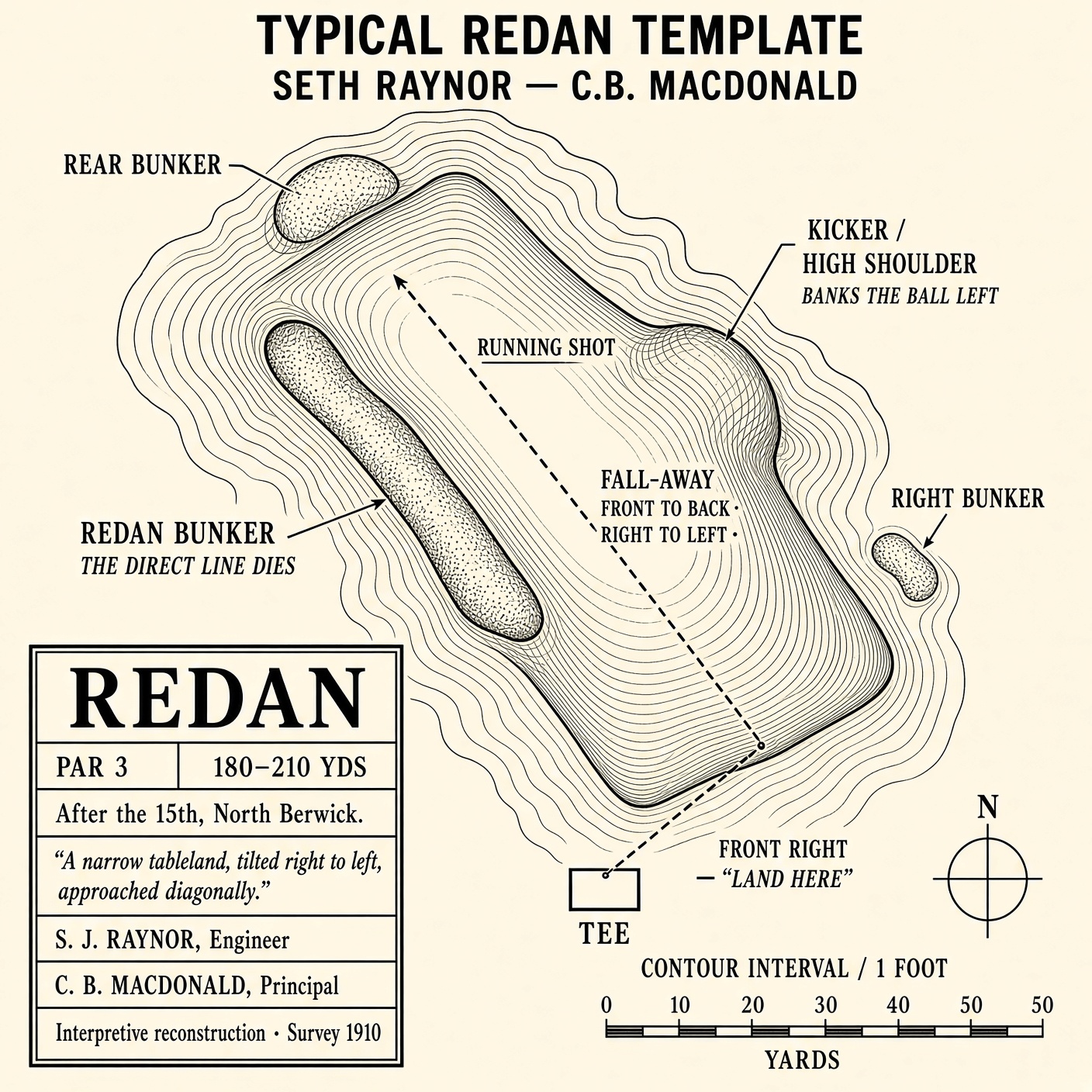
A green set at an angle to the line of play, typically falling from front-right toward back-left, asks the golfer to use the ground as well as the air. A deep bunker protects the direct route. A well-judged shot can land on the higher shoulder and work toward the hole.

Lineage
North Berwick, Scotland
The essential idea
Angle, slope and the running approach
The player’s question
Where can the ball land so that the contour does the rest?

Reverse Redans turn the direction around. The strategic idea matters more than identical orientation.

Redan · Contour and running approach study
I / Heritage

Heritage & strategic purpose

European precedent
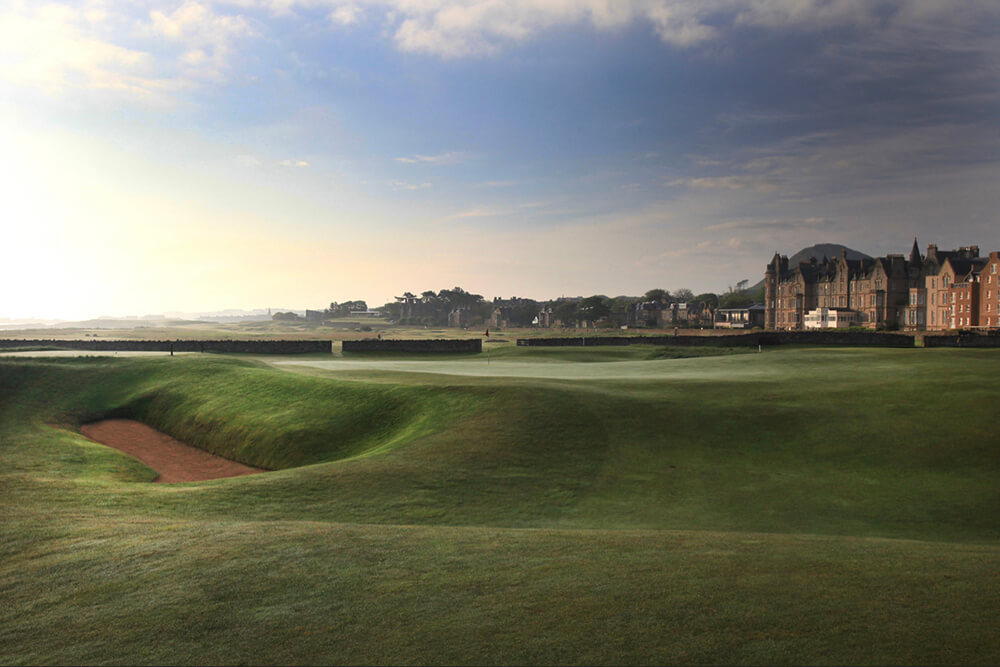
The 15th on North Berwick’s West Links, Scotland.
Primary strategic test
Choose a landing point that uses the diagonal target and its deflection slope.
Geometric identifiers
A green oblique to the line of approach, typically falling from front-right toward back-left, a higher right shoulder and defending sand on the direct left-hand route. Reverse Redans mirror the relationship.
II / Structure

Engineering & earthmoving

Landform & construction logic

The green’s diagonal alignment is only one part of the structure. Its vertical tilt, the height and width of the shoulder, and the bunker’s position decide whether the indirect line is genuinely useful. A drawing showing an angled rectangle cannot convey how strongly a ball will be redirected. The slope and the landing surface must function together.

A raised platform can create a similar strategic relationship where a natural shoulder is absent, but not every Redan should be described as an artificially built plateau. At each site, the important architectural question is how the approach meets the upper edge of the green and how the ground falls toward the defended side.

Shot values & ball flight

A shot aimed toward the higher shoulder can use the ground to move toward the lower portion of the green. A direct shot over the bunker can also succeed, but must stop on a surface that may fall away. Wind, landing angle and firmness decide whether the contour assists the ball or sends it too far.

III / Comparison

Course manifestations

CourseHoleArchitectural variant
Fishers Island Club2A comparatively restrained shoulder and tilt: the recognizable strategy without the most forceful deflection.
Shoreacres14The Redan relationship set within the course’s plateau-and-ravine landscape.
The Greenbrier Resort (Old White)8A Macdonald–Raynor collaboration adaptation of North Berwick’s diagonal target.
IV / The changing target

Architectural nuances & pin strategy

A lower, rearward pin can make the high shoulder an ally, allowing the ball to travel toward a location that is difficult to attack directly. A pin on the upper portion may require less release and can punish the same shot that works well to the back.

Missing below the target can remove the advantage of the contour altogether. The recovery then has to climb a slope or clear defending sand. The strategic reward is not simply avoiding a bunker; it is retaining the land as a means of reaching the hole.

The original / North Berwick West Links

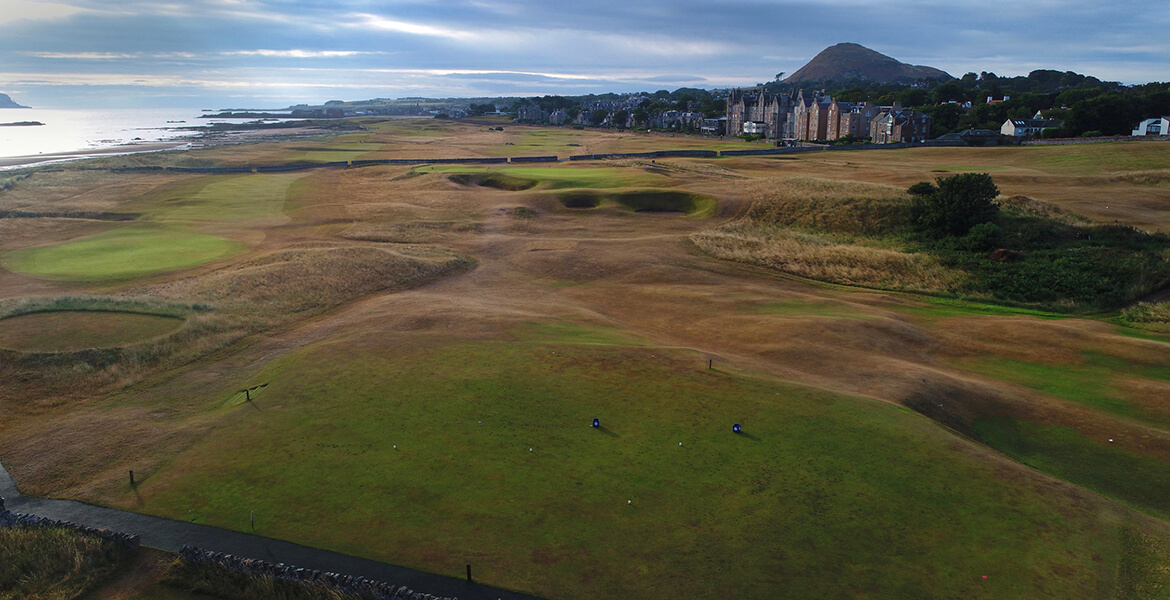
North Berwick’s 15th: the original Redan

Before it became an architectural vocabulary, the Redan was a particular encounter with a particular piece of Scottish ground.

A links hole becomes a model

The par-three 15th on North Berwick’s West Links is the original Redan, one of the most widely imitated holes in golf. The club’s history places its arrival in the westward course extension of 1868, while also noting that later alterations produced the celebrated hole. That distinction matters: the Redan we admire belongs to an evolving links, not a single drawing frozen in time.

Its name brings a military image onto the golf course. A redan is an angled defensive earthwork; the hole’s name is associated with the Great Redan at Sevastopol during the Crimean War. The analogy is apt without being literal. A raised, slanting target and formidable defending sand make the golfer consider how to approach a position that resists a frontal attack.

The ground is part of the shot

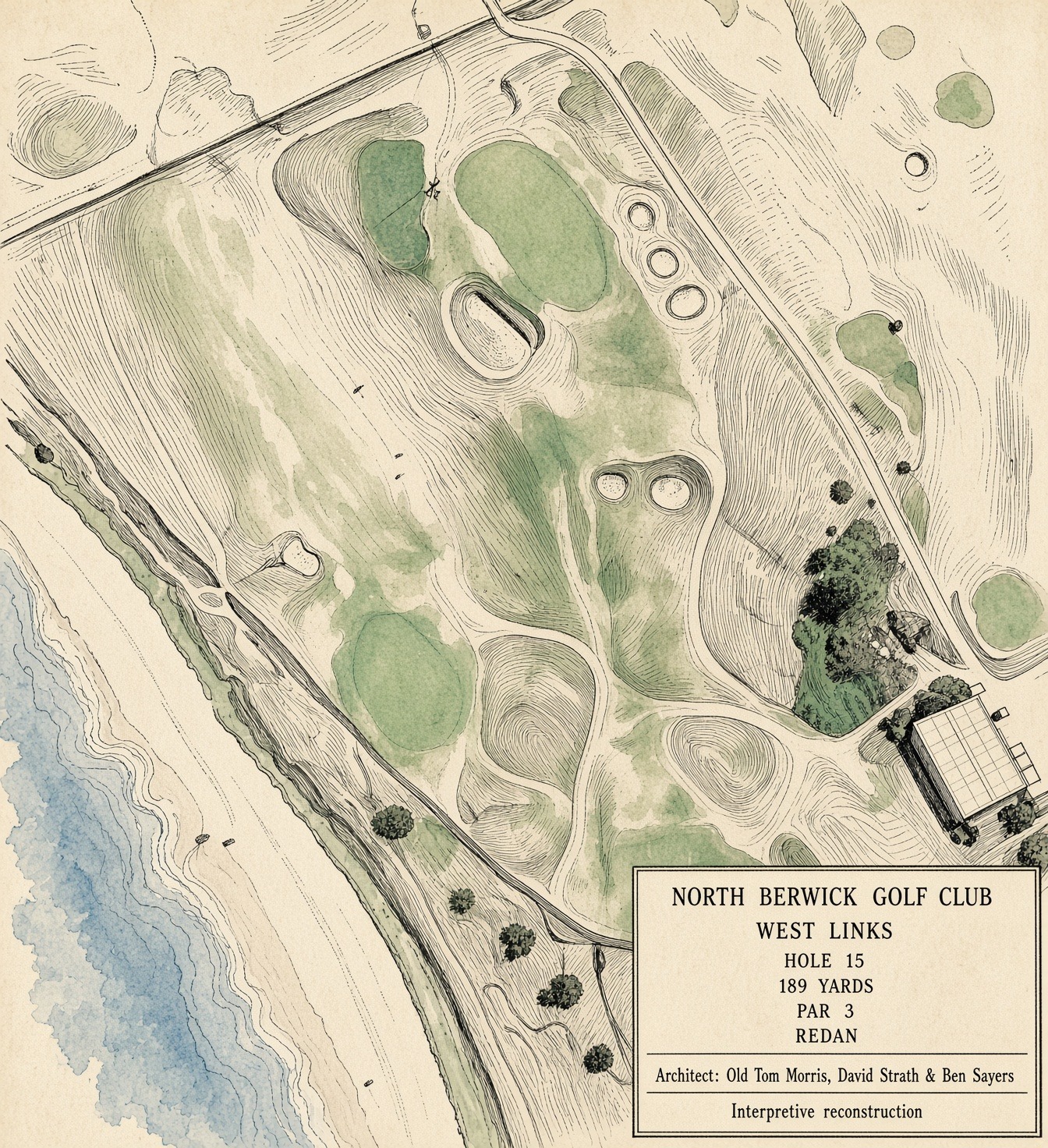
North Berwick’s essential lesson is the relationship between angle and movement. The green lies diagonally across the approach and falls from the higher right side toward the left and rear. The deep front-left bunker makes the direct line intimidating, while the higher shoulder on the right offers another route. A ball landing in the right place can use the slope to travel toward a flag that would be difficult to attack head-on.

This is not a rule that every shot must be run along the ground. Wind, firmness, the hole location and the player’s ability change the sensible choice. A direct aerial approach can work, but it asks for control of carry and stopping distance on a surface that falls away. The running alternative asks for an equally thoughtful judgment: not merely where the ball will land, but how it will move afterward. The bunker, shoulder and tilt are a single strategic system.

From Macdonald’s model to Raynor’s language

Charles Blair Macdonald made celebrated British holes the starting points for his American architecture. At National Golf Links of America in Southampton, the Redan became one of those “ideal hole” adaptations. Seth Raynor entered the project as a surveyor and civil engineer, helping translate Macdonald’s architectural ideas into a built landscape. National’s design should therefore be credited to Macdonald, with Raynor’s surveying and construction contribution clearly distinguished—not described as an independent Raynor commission.

The Redan’s influence on Raynor is best understood through that collaboration, rather than an assumed personal discovery at North Berwick. In his later independent work, Raynor carried forward the combination of an angled target, defending bunker and helpful contour, adjusting it to new sites. Camargo and Fishers Island belong to the broader story of his template architecture. The achievement was not to reproduce a Scottish green with photographic fidelity; it was to preserve its strategic question while changing the scale, setting and execution. A reverse Redan can turn the slopes the other way and still ask the same thing: can you use the land to reach a well-defended hole?

North Berwick · The original Redan
North Berwick West Links · 15th, Redan
North Berwick · The Redan in its links setting
North Berwick West Links · 15th, Redan
North Berwick · Green and defending bunker
North Berwick West Links · 15th, Redan
Interpretive studies

From links landscape to template

North Berwick · Interpretive course sketch